Closed Die Forging: Process, Benefits, and Applications for High-Strength Components
Discover how closed die forging creates superior strength components for automotive, aerospace, and heavy machinery through controlled metal deformation.

Closed die forging, also known as impression die forging, is a metal forming process that produces the strongest components available in manufacturing. By forcing heated metal into precisely machined dies under extreme pressure, this process creates parts with superior mechanical properties essential for safety-critical applications.
What is Closed Die Forging?
In closed die forging, a heated metal workpiece (billet) is placed between two dies that contain the negative impression of the desired shape. When the dies close under pressure from a hammer or press, the metal flows to fill the die cavity, taking its final form.
Unlike open die forging where the metal is shaped between flat dies, closed die forging produces near-net-shape components with precise dimensions and minimal material waste. The process aligns the metal's grain structure along the component's contours, resulting in exceptional strength and fatigue resistance.
The Closed Die Forging Process
1. Die Design and Manufacturing
Precision dies are machined from high-grade tool steel (H13, H11) or nickel-based superalloys. Die design accounts for metal flow, draft angles (typically 3-7°), parting lines, and flash gutters. CAD/CAM and FEM simulation optimize the design before costly die manufacturing begins.
2. Billet Preparation
Raw material is cut to precise dimensions based on the final part weight plus flash allowance. Billet quality directly affects final component quality—material certification and inspection are essential.
3. Heating
Billets are heated in induction or gas-fired furnaces to the appropriate forging temperature:
- Carbon Steel: 1100-1250°C
- Alloy Steel: 1100-1200°C
- Aluminum: 400-480°C
- Titanium: 870-980°C
Temperature uniformity is critical—overheating causes grain growth while underheating leads to incomplete die filling and cracking.
4. Forging Operation
The heated billet is positioned in the lower die. The upper die descends with tremendous force—from 500 tons for small parts to over 50,000 tons for large aerospace components. Depending on complexity, multiple forging stages may be required: blocking (rough shape), finishing (final shape), and coining (precision sizing).
5. Flash Trimming
Excess material (flash) that flows outside the die cavity is trimmed in a separate trimming die or by machining. Flash represents 10-50% of input material and is recycled.
6. Heat Treatment and Finishing
Forgings typically undergo heat treatment (normalizing, quenching, tempering) to achieve specified mechanical properties. Surface treatments, machining, and final inspection complete the process.
Types of Closed Die Forging Equipment
Hammer Forging
Mechanical or pneumatic hammers deliver rapid, repetitive blows. Best for parts requiring multiple hits to fill complex die cavities. Typical for automotive and general industrial components.
Press Forging
Hydraulic or mechanical presses apply continuous, controlled pressure. Produces more uniform grain structure and is preferred for large, thick sections and aerospace applications.
Screw Press Forging
Combines hammer energy with press control. Excellent for precision aluminum and titanium forgings.
Advantages of Closed Die Forging
Superior Strength
The forging process refines grain structure and eliminates porosity, voids, and inclusions common in castings. Forged components offer 20-50% higher tensile and fatigue strength compared to cast or machined parts.
Directional Strength
Grain flow follows the component's contours, placing the strongest grain orientation where stresses are highest. This is impossible to achieve with machining from bar stock or casting.
Reliability
Uniform, predictable properties throughout the part. No hidden porosity or shrinkage defects that could cause catastrophic failure. Essential for safety-critical applications.
Economy at Volume
While die costs are significant (₹5-50 lakhs / $6,000-$60,000), per-part costs become very competitive at volumes above 1,000-5,000 pieces due to minimal machining and high material utilization.
Materials for Closed Die Forging
Almost any metal can be forged, with common choices including:
- Carbon Steels: 1020, 1040, 1045 - general industrial applications
- Alloy Steels: 4140, 4340, 8620 - high-strength applications
- Stainless Steels: 304, 316, 17-4 PH - corrosion-resistant applications
- Tool Steels: H13, D2 - tooling and dies
- Aluminum Alloys: 2014, 6061, 7075 - lightweight, aerospace
- Titanium Alloys: Ti-6Al-4V - aerospace, medical
- Superalloys: Inconel 718, Waspaloy - jet engines, gas turbines
Applications by Industry
Automotive
Connecting rods, crankshafts, steering knuckles, wheel hubs, gears, CV joints. Closed die forging dominates safety-critical drivetrain and suspension components.
Aerospace
Landing gear components, turbine discs, compressor blades, structural fittings. Titanium and superalloy forgings meet extreme performance requirements.
Oil & Gas
Valve bodies, flanges, wellhead equipment, pipeline fittings. Forged components withstand high pressures and corrosive environments.
Mining & Construction
Bucket teeth, track links, rock crusher components. Impact and wear resistance from forged grain structure extends service life.
Railway
Axles, wheels, couplers, brake components. Reliability under cyclic loading makes forging essential for rail safety.
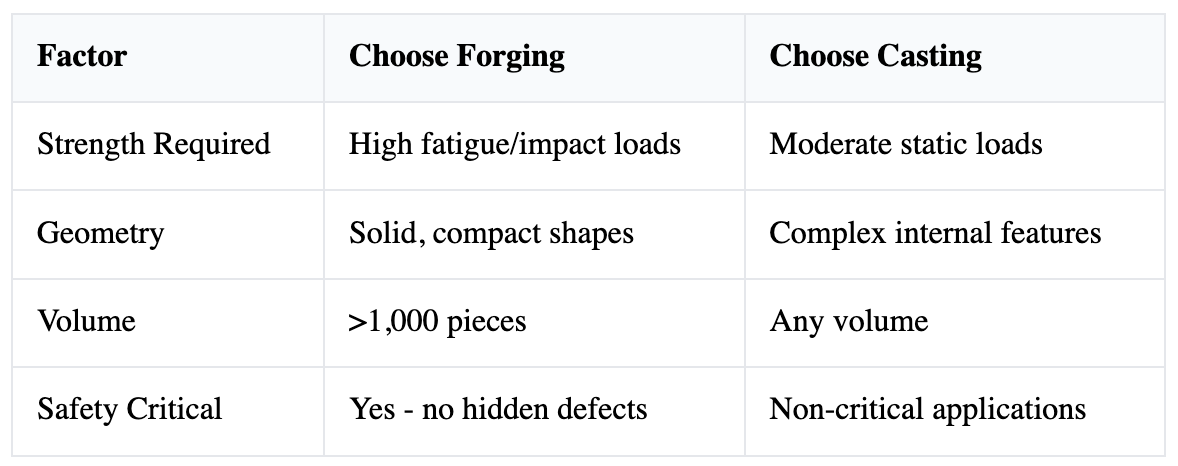
Forging vs Casting: When to Choose Forging
India's forging industry ranks among the top five globally, with advantages including:
- Scale: Over 400 forging units with capacities from 500kg to 16,000 tons
- Cost: 30-40% cost savings versus Western sources
- Quality: ISO, IATF, AS9100 certified facilities serving global OEMs
- Experience: Decades of export experience with international standards
Conclusion
Closed die forging produces the highest-integrity metal components available—essential wherever strength, reliability, and safety cannot be compromised. Understanding the process, its advantages, and appropriate applications enables better sourcing decisions for your critical components.
Need high-quality forgings for your application? Request a quote with your specifications, or contact us to discuss your requirements with our engineering team.